

Mindfulness skills are the foundation of all Dialectical Behavioral Therapy (DBT) skills training. The problems addressed by core mindfulness skills are knowing who you are, where you are going in your life, and the inability to control what goes on in your mind. Mindfulness encourages you to live in the moment by focusing on the present.
In DBT there are three primary ways used to refer to states of mind.
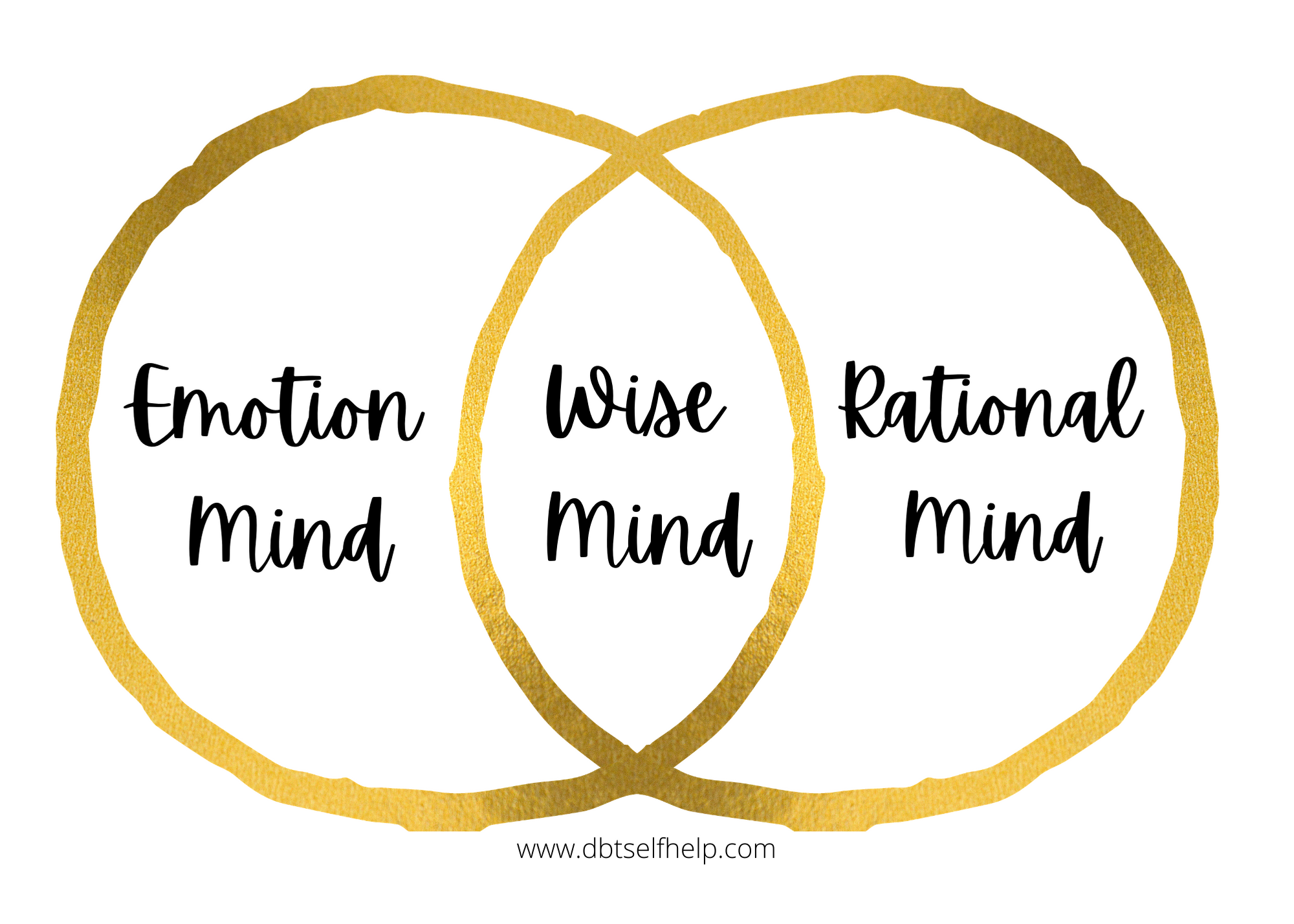
They are: Emotion Mind, Rational Mind, and Wise Mind.
Emotion Mind
Emotion mind occurs when your thoughts are being controlled by your emotions. Logical thinking and planning are difficult, facts may be distorted or made larger or more important. Thoughts and behaviors might be said to be “hot,” and the energy of the behavior tends to match the intensity of the feelings.
Some examples of emotion mind might be:
- Fighting with someone you disagree with
- Taking an impulse trip without planning
- Cuddling a puppy
- Flying a kite for fun
- Snapping at a salesperson because they don’t have what you want
- Purchasing something you can’t afford
Rational Mind
Rational mind is when you can think logically or be rational and reasonable about what is occurring. Analytical and empirical thinking are predominant. Thoughts and behaviors might be said to be “cool,” that is, not emotional in their approaches to solving problems.
Some examples of Rational Mind might be:
- Looking up the bus schedule before walking to the stop to wait
- Planning for an outing several days in advance
- Measuring the ingredients to bake a cake
- Asking a salesperson for details about something you want to buy
- Studying for a test
Wise Mind
Wise mind is the point of overlap between emotion and reasonable mind, like on the Venn diagram. Wise mind is part reason and part emotion and what makes you know you’re in this mind is often a sense of intuition. It can sometimes be described as that ‘aha’ moment.
DBT founder Marsha Linehan describes wise mind as “that part of each person that can know and experience truth. It is where the person knows something to be true or valid. It is almost always quiet. It has a certain peace. It is where the person knows something in a centered way.”
Finding Wise Mind
Wise mind can be difficult to find. Everyone has a wise mind even if they struggle to access it.

Linehan uses this metaphor: “wise mind is like a deep well in the ground. The water at the bottom of the well, the entire underground ocean is wise mind. But on the way down there are often trap doors that impede progress. Sometimes the trap doors are so cleverly built that you believe there is no water at the bottom of the well. The trap door may look like the bottom of the well. Perhaps it is locked and you need a key. Perhaps it is nailed shut and you need a hammer, or it is glued shut and you need a chisel.”
Wise mind can feel different to each person. Here are some ways to experience it:
- Wise mind is sometimes experienced in the center of the body (belly), in the center of the head or between the eyes.
- Sometimes a person can find it by following their breath in and out.
- You might have a sense that you’re stepping back from the situation.
- Some people experience wise mind when making a decision that they know is absolutely the right thing to do. They know they are in wise mind because they don’t have any sense of dread or anxiety. There is absolutely no doubt.
- It is like the calm that follows the storm, something experienced immediately following a crises or enormous chaos.
- It’s about getting to the heart of the matter, seeing or knowing something directly or clearly.
- It is grasping the whole picture where only parts were previously understood.
- It is “experiencing” the right choice in a dilemma, when the feeling comes from deep within rather from a current emotional state.
- Wise mind may also feel reluctant. You may want the answer to be different, to be easier or less painful but you know the truth deep down.

Exercise
Set an alarm clock for a certain period of time each day (like every hour). When the alarm goes off, check in with yourself. How are you experiencing the moment? Observe your thoughts and emotions. Don’t judge them as right or wrong, just observe and describe it by writing it down. At the end of the day, do you see a pattern? Have you learned anything about yourself? No matter what the experience you had, allow yourself to let go of all that happened. Let go of the judgments. Be in the moment.
Wise mind takes practice to find and tap into. The more you practice, the easier it will be to slip into wise mind when you need to.
0 Comments